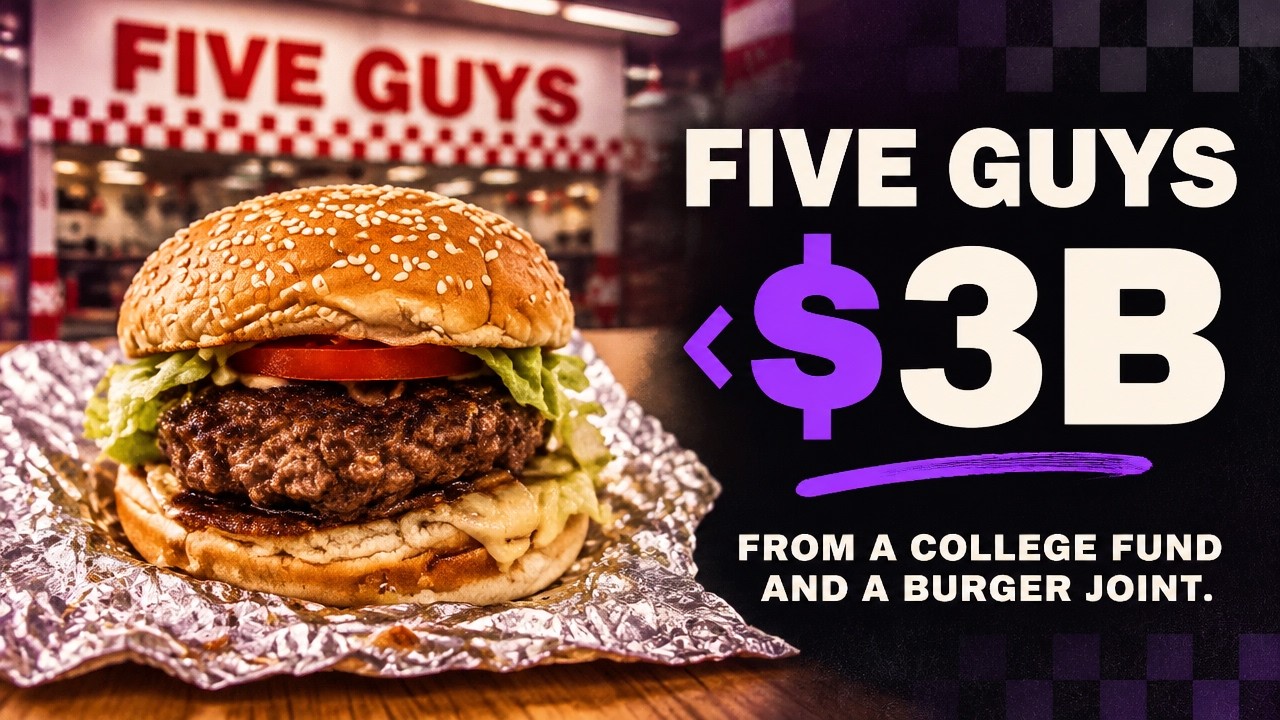
The Story
Jerry and Janie Murrell gave their two oldest sons a choice: start a business, or go to college. They chose the business, and the family used the college money to open a burger joint in an Arlington, Virginia strip mall. In 2024 Five Guys sold $2.3 billion of food in the U.S. and more than $1 billion abroad (Restaurant Business).
Why Jerry refused to franchise for 16 years, how Virginia sold out in three days once he gave in, the restaurants with no freezers, the two secret audits a week, the President's cheeseburger order, and how one family still owns nearly 2,000 restaurants.
Quick Answers
Who founded Five Guys?
Jerry and Janie Murrell and their sons opened the first Five Guys in Arlington, Virginia, in 1986, using the money saved for the boys' college tuition.
Why is it called Five Guys?
The five guys were Jerry Murrell and his four oldest sons. A fifth son, Tyler, was born later.
When did Five Guys start franchising?
In 2002, after 16 years of refusing. The rights to Virginia sold in three days, and options for more than 300 restaurants sold in under 18 months.
Does Five Guys use frozen food?
No. The company says its restaurants have no freezers, only coolers. Fries are cut from fresh potatoes and cooked in peanut oil.
How big is Five Guys?
Nearly 2,000 restaurants. In 2024 it sold $2.3 billion of food in the U.S. and more than $1 billion abroad, according to Restaurant Business.
The Transcript
Read the full transcript
Transcript of the narration, lightly edited for readability. Tap a timestamp to jump to that moment in the video.
0:00For 16 years, one family refused to franchise its burger joint. The father was, in his words, dead set against it. Then his sons pulled him into it. Kicking and screaming, he said. When they finally started selling franchises, the rights to Virginia went in three days. In under 18 months, they sold options for more than 300 restaurants. Today, there are nearly 2,000 in more than 25 countries. So how did a burger joint paid for with a college fund become a global chain without ever spending much on advertising? This is the story of Five Guys.
0:37Arlington, Virginia, 1986. Jerry Murrell had tried a string of business ideas, and most of them had failed. He and Janie had done well in insurance and financial planning. His first idea for a food business was a chuck wagon selling burgers and fries. His son Matt's reaction, as he told the Washington Post: "Oh my God, he's lost his mind." But Jerry had a memory from childhood of a burger stand back in Michigan. "I knew a guy who did nothing but sell hamburgers," he said. "I just always thought that if you sold hamburgers, you would do all right." His two oldest sons, Jim and Matt, didn't want to go to college. So Jerry and his wife, Janie, gave the boys a choice: start a business, or go to college. It was a blended family. Janie came into the three oldest boys' lives when they were eight, six and three. "It was never like I had three stepchildren," she said. "We were always a family." They chose the business. Instead, Jerry told Inc. magazine, "we used their college tuition to open a burger joint." The five guys were Jerry and his four oldest sons. Later, a fifth son, Tyler, came along, and the name still fit.
1:51The first store was a carry-out shop in a strip mall at Columbia Pike and Glebe Road. For the fries, they bought 50 bottles of peanut oil off a store shelf. "We didn't know they made it in bulk," Matt said. On the first morning, they opened at 11:00. Nobody came in until 11:30. Jerry had a theory he'd picked up from his mother: you can always make money if you know how to make a good burger. So they made almost nothing else. Burgers and fries. The beef was fresh, never frozen. The fries were cut from fresh potatoes and cooked in peanut oil. To this day, the company says its restaurants have no freezers, just coolers. "The magic to our hamburgers," Jerry told Inc., "is quality control." The family tested 16 mayonnaises before picking one. Anything that didn't meet the standard came off the menu. Coffee was one of them. The company dropped it over quality, except at a few airport locations.
2:56The fries came from a boardwalk fry shop Jerry studied in Ocean City, Maryland. Most of the potatoes, Inc. reported, came from Idaho, grown north of the 42nd parallel. "Potatoes are like oak trees," Jerry said. "The slower they grow, the more solid they are." Even the cooking had rules. Inc. reported that the fries were soaked in water and pre-fried, so they wouldn't soak up oil. The buns were toasted on the grill. While you waited, there were free peanuts in the shell, and all the toppings were free, too. The family argued about everything, down to whether the pickles went above the tomatoes or below them. The rule they settled on: everything had to stay together when the burger was flipped. It worked, but slowly. By 2001, after 15 years, the family had five restaurants, all around Washington, D.C.
3:46Each new store cost $300,000, and the banks wouldn't help. "My kids wanted to franchise from the start," Jerry said, "because we couldn't get the money to expand on our own." Jerry said no. "I was dead set against franchising. I didn't think we'd be able to control the quality." And they were afraid of something else. If they franchised, they worried they would be pressured to add to the menu. Burgers, fries, hot dogs and grilled cheese were all they wanted to sell. Customers kept offering money anyway. One offered $30,000 to fund another store. There was more to it than that. In the late 1990s, a trusted employee had stolen from the register. "Five Guys was something so personal to us," Jerry told Family Business magazine, "and we were going to let strangers have at it." His sons kept pushing. At one point, they handed him a copy of Franchising for Dummies. "I gave a lot of pushback," Jerry said, "because I was scared to death." In the end, he gave in.
4:53"When we started to sell franchises in 2002," Jerry told Inc., "Virginia went in 3 days." The first franchised restaurant opened in 2003. In just under 18 months, according to the company, it sold options for more than 300 stores. The terms were strict. Buyers had to take at least five franchises, at $45,000 each, plus 6% of sales. By the spring of 2006, the Washington Post counted 87 Five Guys, with about 1,000 more on the way. Each store, the company said, took in about a million dollars a year. Jerry still didn't trust strangers with his burgers, so every restaurant got two outside audits a week, one of them a secret shopper, grading the food, the service, even the bathrooms. The best-scoring crews split a $1,000 bonus. In one year, Inc. reported, the company paid out $7 to $8 million in those bonuses. It spent far less on advertising than most chains. By 2009, there were 575 Five Guys in the United States and Canada, with sales of $483 million. New ones were opening at a rate of about four a week. Of those, about 90 belonged to the company itself. The rest were franchised, each paying Five Guys 6% of its sales. To keep up, the family built its own supply chain. By 2013, more than 20 bakeries made its buns.
6:27On May 29th, 2009, a customer walked into a Five Guys in Washington and ordered a cheeseburger with lettuce, tomato, jalapeños and mustard. It was the President of the United States. Barack Obama's surprise lunch stop made national news. Critics called it a photo opportunity. His press secretary, Robert Gibbs, insisted it wasn't. "I can assure you," he said, "it was done simply for the benefit of the appetite of the commander in chief." Either way, the president had just ordered a Five Guys burger in front of the national press. In 2010, Five Guys opened its first restaurant outside the United States, in Canada. In 2012, it opened its 1,000th restaurant, and sales approached $1.1 billion. The family's fear of strangers hadn't gone away. It had turned into a system: the same two audits a week, the same $1,000 bonuses, now running across more than 1,000 restaurants. In July 2013, it crossed the Atlantic, to London's Covent Garden.
7:35Through all of it, Five Guys stayed in the family. In 2013, Family Business magazine reported that the seven Murrells held equal shares, and that major decisions needed a unanimous family vote. Jerry kept the title of chief executive. He described his job differently. "Really, I'm just the janitor," he said. "They let me pretend I'm running things." His sons ran the rest. Jim built the menu. Matt ran operations and store design. Chad ran training. Ben ran technology. And Tyler, the son who came after the name, ran the bakeries. The family ran itself with blunt rules. Salaries depended on each person's job, not on age or seniority. "This type of transparency minimizes dissension," Chad said. And the Murrells still took a family vacation together every year. "The family comes first here," Tyler said. By 2013, a third generation had arrived. Children of Jim and Matt were working for Five Guys, and the growth showed no sign of slowing. "This isn't a train we can slow down in a snap," Chad said.
8:42In 2024, according to Restaurant Business, Five Guys sold $2.3 billion worth of food in the United States, and more than a billion dollars more abroad, in 29 countries. More and more of that growth comes from abroad. In 2024, Restaurant Business reported, the number of Five Guys outside the United States grew 10%, to 450. In February 2026, the family marked 40 years. The company now counts nearly 2,000 restaurants on five continents. Not every customer is happy about the price of that quality. In March 2024, a $24 receipt for one person's meal went viral. "Five Guys prices are out of control," the poster wrote. Two years earlier, one of the company's executives had put the prices down to fresh ingredients. Nothing is frozen. "We really just wanted to make burgers we could be proud of," Jerry said.
9:41It started with a choice two teenagers made: a business, or college. For 15 years, the answer was five restaurants. Then the family let strangers in, and checked on every one of them twice a week. 40 years later, the menu still fits on one board: burgers, fries, hot dogs and shakes. And the Murrell family still runs it.
The Sources
Every claim in the video is cited. These are the key sources for Five Guys. See our editorial standards for how we work, and if you spot something wrong, please tell us.
Key sources
- Inc. magazine (Jerry Murrell, 2010)
- Family Business Magazine (2013)
- The Washington Post (2006)
- Five Guys company history and 40th-anniversary materials (2026)
- Restaurant Business (2025)
- coverage of President Obama's Five Guys visit (May 29 2009)
- Entrepreneur (2024)
Photo credits
Flickr and Library of Congress: Mike Mozart, CC BY 2.0 · Mack Male, CC BY-SA 2.0 · Håkan Dahlström, CC BY 2.0 · Jerry Huddleston, CC BY 2.0 · D.L., CC BY-SA 2.0 · James Brooks, CC BY 2.0 · Random Retail, CC BY 2.0 · Mr. Blue MauMau, CC BY 2.0 · GoToVan, CC BY 2.0 · Jazz Guy, CC BY 2.0 · Elsie Hui, CC BY 2.0 · Elliott Brown, CC BY-SA 2.0 · Tjeerd Wiersma, CC BY 2.0 · Carol M. Highsmith, Library of Congress (public domain). Satellite imagery: Esri World Imagery (Esri, Maxar, Earthstar Geographics).
About this video
Narration is synthetic (AI voice). No rights-cleared photographs of the Murrell family were available; they appear through places, food and their own words. This channel is not affiliated with Five Guys.
Corrections: corrections@howitgotbigstudios.com


