The Beginning
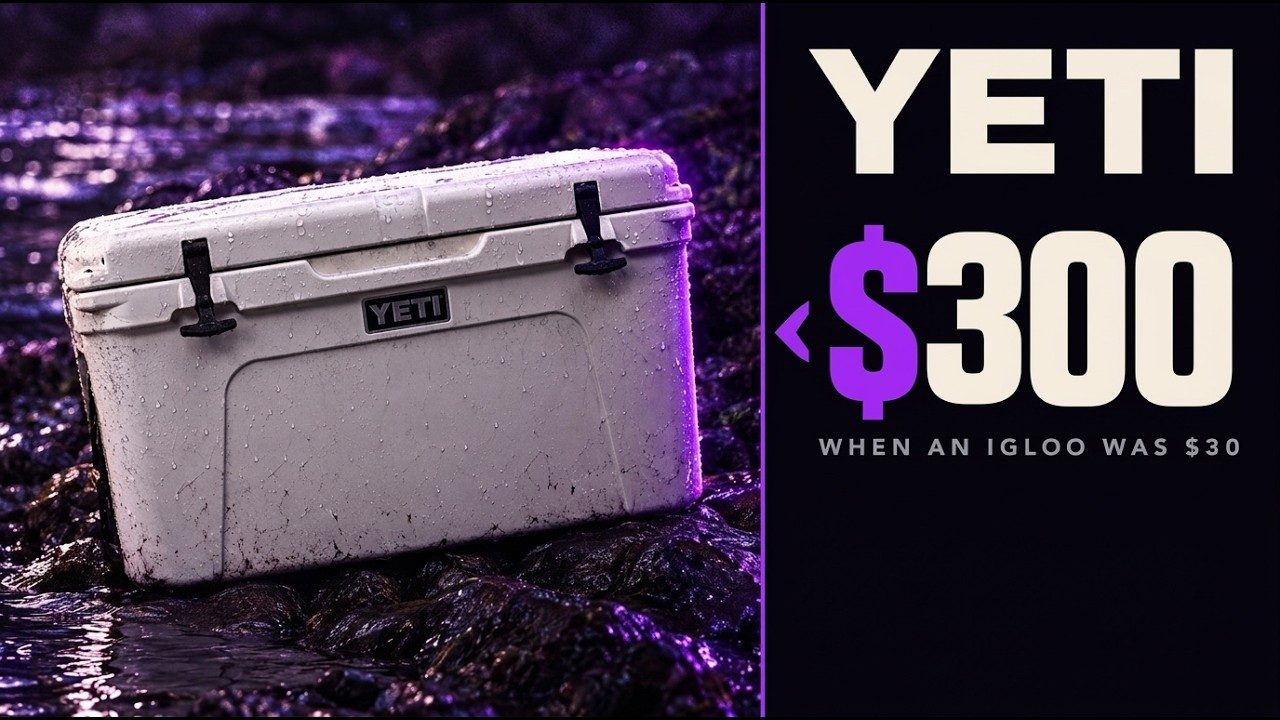
Ryan and Roy Seiders grew up in Driftwood, Texas, with a father who built his own tools when he could not buy the right ones. That habit led them to build a cooler that would not fail, and to charge ten times the going price for it.
Ryan started a fishing rod company, Waterloo Rods, in the mid-1990s, while Roy worked on rigging boats. Both kept running into the same problem: most coolers were not durable enough for fishing and boating.
The First Bet
In January 2006 the brothers traveled to Thailand and found a durable, rotomolded cooler. They began importing it under the name Roughneck.
They then designed a cooler of their own. The first Tundra shipped in April 2008 with a price tag of $300, at a time when a standard cooler cost around $30.
The Turning Point
In 2014, Yeti launched the $30 Rambler cup, which brought the brand to a much wider audience.
Sales grew from about $5 million in 2009 to about $29 million in 2011. In June 2012, Cortec Group paid $67 million for two-thirds of the company.
In 2014, Yeti launched the Rambler, a vacuum-insulated steel cup that sold for $30. It put the brand within reach of far more customers than a $300 cooler could.
The Scale
Sales dropped in 2017, a slowdown the video attributes to several causes, including a customer boycott.
Yeti went public on October 25, 2018, at an initial valuation of $1.4 billion. It has since widened its product line and its retail presence, reaching revenue of about $1.87 billion in 2025.
The Timeline
Ryan Seiders sells his fishing rod company.
Ryan and Roy Seiders found Yeti and travel to Thailand to find a manufacturer.
The first $300 Tundra cooler ships in April.
Cortec Group buys two-thirds of the company for $67 million.
The $30 Rambler cup launches and widens the brand's audience.
Yeti goes public on October 25 at a $1.4 billion valuation.
Revenue reaches about $1.87 billion.
The Sources
Every claim in the video is cited. These are the key sources for Yeti. See our editorial standards for how we work, and if you spot something wrong, please tell us.
Key sources
- YETI Holdings IPO filings (2016, 2018) and annual report (FY2025)
- Inc. magazine
- Bloomberg Businessweek
- Business Insider investigation (Ivan Brown and the Philippine factory)
- The Wall Street Journal (Cortec deal, 2012; IPO valuation, 2016)
- Texas Monthly
- Interagency Grizzly Bear Committee
- YETI film on Roger Seiders and Flex Coat
Photo credits
Wikimedia Commons unless noted.
- Northwest Rafting Company, CC BY 2.0 (YETI Tundra coolers)
- DiamondBack Covers, CC BY-SA 2.0
- ms.akr, CC BY 2.0 (Austin dealer sign, 2012)
- Tony Webster, CC BY 2.0
- kylem35, CC0
- Tailscraft, CC BY 4.0
- Sarah Stierch, CC BY 4.0
- Michael Salazar, CC BY-SA 2.0
- Victor Grigas, CC BY-SA 4.0
- Ken Lund, CC BY-SA 2.0
- Ishmael Daro, CC BY 2.0
- Hvn73, CC BY-SA 3.0
- Larry D. Moore, CC BY 4.0
- Ajay Suresh, CC BY 4.0
- Nicolas Henderson, CC BY 2.0
- Djmaschek, CC BY-SA 4.0
- ejmc, CC BY 2.0
- Asyarch, CC BY-SA 3.0
- Jackyzhao, CC BY-SA 4.0
- Rishi Saran, CC BY-SA 3.0 / CC BY 4.0
- Bureau of Land Management, CC BY 2.0
- National Park Service / Jim Peaco, public domain
- U.S. Fish and Wildlife Service, public domain
- Satellite imagery: Esri World Imagery
Notes on the footage
No photograph of Roy or Ryan Seiders is used; the brothers appear through objects, places and their own words. The hinge, the dealer-margin document and the Ivan Brown conference-room nameplate are labelled reconstructions. Stand-in photos (rotomolding, rod building, a $30 cooler, RTIC) are labelled as such. No image in this film is AI-generated. This channel is not affiliated with YETI.
Corrections: corrections@howitgotbigstudios.com